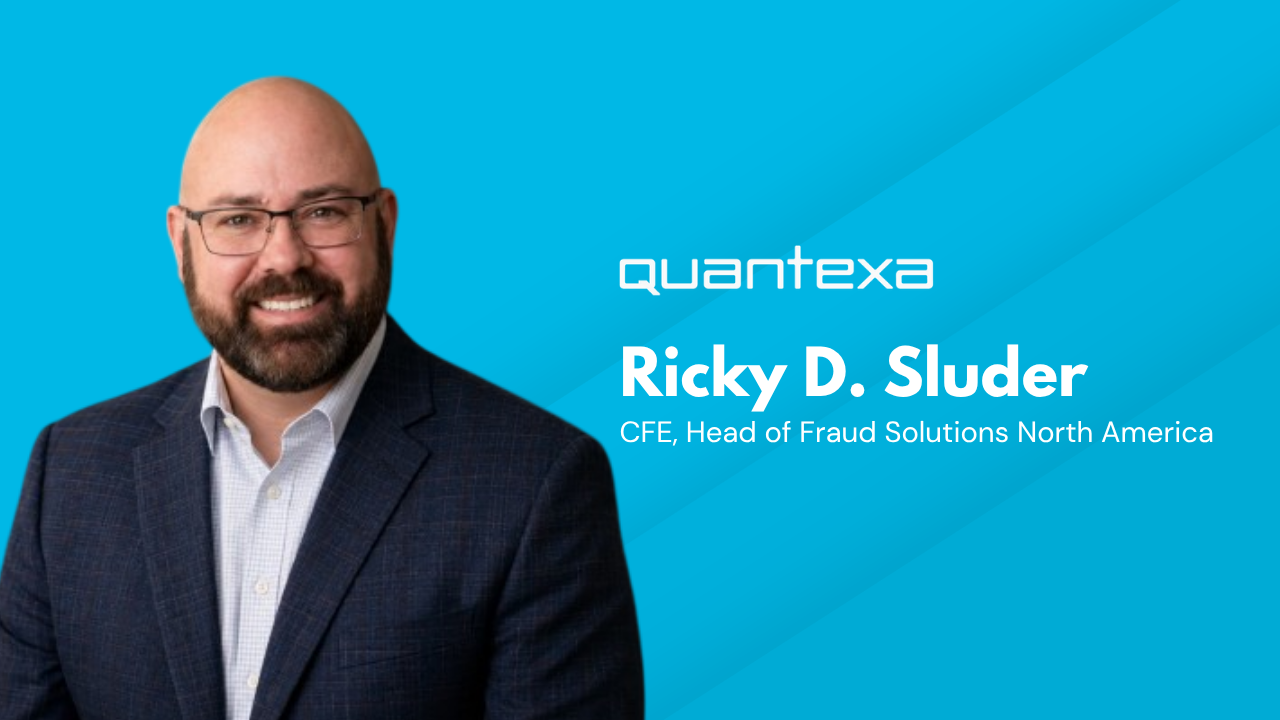
By Ricky Sluder, CFE, Head of Fraud Solutions North America, Quantexa
1. Why is looking at a single transaction no longer enough to spot sophisticated fraud?
For most of my career, fraud detection was built around the transaction: was this payment out of pattern, did it match a rule, was it above a threshold. That worked when fraud was mostly opportunistic and one-dimensional. Today’s fraud rings operate like businesses. They recruit mules, rotate devices, stagger amounts below detection thresholds, and spread activity across dozens of accounts and institutions so no single transaction ever looks alarming on its own. If you’re only scoring the transaction in front of you, you’re judging one frame of a much longer film. The signal that matters is often invisible at the transaction level and only becomes visible when you connect that transaction to the network of people, devices, and accounts around it. That’s the premise behind contextual decision intelligence: you’re not asking whether a transaction looks suspicious in isolation, you’re asking whether the pattern of behavior makes sense given everything you know about the entity and everything it’s connected to.
2. How can contextual data help investigators connect seemingly unrelated signals and uncover fraud?
Contextual data means taking information that already exists across an organization, and often outside it, and resolving it around real-world entities instead of leaving it siloed in separate systems. An investigator might have a name in one system, a device ID in another, an address in a third, and a beneficiary account in a fourth, and never realize they belong to the same bad actor because nothing links them. When you build a single contextual view of a person or business, resolving identities across structured and unstructured data, patterns emerge that were always there but invisible: a shared phone number across a dozen “unrelated” applications, a device that touches accounts which never transact with each other but log in from the same IP within minutes of each other. Individually, that’s noise. In context, it’s a network. That shift from looking at data points to looking at the relationships between them is what lets investigators uncover fraud rings instead of one fraudulent transaction at a time.
Media Partner
3. What role does graph-based analytics play in identifying hidden relationships between people, accounts, devices, and transactions?
Graph analytics is how you operationalize context at scale. Once entities are resolved and the data is connected, what you have is a network, and a network is a graph problem: who touches what, how many hops separate two accounts, which nodes sit at the center of unusually dense clusters. That’s exactly the structure fraud rings create without meaning to. Mule networks, synthetic identity rings, and first-party fraud collectives all leave a graph signature: shared attributes, shared infrastructure, unusual centrality. A rules engine looking at one account at a time will never see that a hundred “different” customers share the same three devices. Graph analytics surfaces that in seconds, and it lets you score risk not just on an individual’s behavior but on the company they keep, which is often the more honest signal.
4. Where do traditional fraud systems struggle when fraud and cyber threats start to overlap?
Most fraud and cyber programs still sit in separate organizational silos, running separate systems on separate data. That made sense when account takeover and payment fraud were distinct problems. They aren’t anymore. A credential stolen in a phishing campaign feeds an account takeover, which feeds a fraudulent transfer, which routes through a mule network the fraud team has never heard of, because the cyber team owns the breach data and the fraud team owns the transaction data. Traditional systems struggle because they were built to detect a category of bad behavior, not to follow an attacker’s full path across categories. You need the identity resolution and device intelligence that cyber teams generate sitting in the same contextual view as the transaction and account data fraud teams generate. Without that convergence, you’re always investigating the last step of the attack instead of the whole chain.
5. How can organizations use AI and Decision Intelligence without losing the human judgment needed in fraud investigations?
The goal isn’t to replace the investigator’s judgment, it’s to stop wasting it on the ninety percent of alerts that don’t deserve it. AI is very good at triage: resolving entities, scoring networks, surfacing the handful of cases out of thousands that actually warrant a look. Decision Intelligence, done right, gives the investigator the full contextual picture the moment they open a case, including the network, the history, and the reasoning behind the score, instead of a black-box number they have to take on faith. That transparency is what preserves judgment. An investigator who can see why a case was flagged, and can push back on it, stays sharp; one who’s just clicking “approve” on a score they don’t understand doesn’t. The organizations getting this right are using AI to compress the investigation, not to replace the investigator’s decision at the end of it.
6. With 30 years in fraud prevention, what has changed most about the way fraudsters operate?
Fraud used to be committed by individuals. Now it’s run by organizations. I’ve watched fraud go from a lone actor testing a stolen card number to coordinated networks that recruit money mules on social media, buy synthetic identities in bulk, and test their techniques against multiple institutions simultaneously to see what gets through. The tooling changed too. Generative AI now produces convincing fake documents and voice clones on demand, and scam operations run with the same playbooks and KPIs as legitimate call centers. What hasn’t changed is the underlying economics: fraudsters go where the friction is lowest and the payoff is highest, and they move fast when they find a gap. Institutions still fighting this with static rules built for a lone-wolf era are always going to be a step behind an adversary that industrialized years ago.
7. What should financial institutions prioritize today to build a more proactive fraud strategy?
Start with entity resolution. You cannot build a proactive strategy on data that doesn’t know who your customers actually are and how they connect to one another. Then invest in breaking down the walls between fraud, financial crime, and cyber teams, because the fraudsters certainly aren’t respecting those boundaries. Beyond that, I’d prioritize shifting spend earlier in the lifecycle, to onboarding and account opening, because it’s far cheaper to catch a synthetic identity before it’s approved than to unwind years of laundered mule activity after the fact. And build for explainability from day one. Regulators, customers, and your own investigators are all going to ask why the system made a given decision, and if you can’t answer that, you’ll end up throttling your own AI out of caution. Proactive isn’t a single control, it’s an operating model built around context, collaboration, and transparency.
8. What is one common assumption about fraud detection that organizations need to rethink?
That more data automatically means better detection. I’ve seen institutions spend years and enormous budgets accumulating data feeds (bureau data, device data, behavioral biometrics) and still miss obvious fraud rings, because all that data sits unconnected in different systems, describing the same customer in ten different ways. Volume without context is just noise with a bigger storage bill. The assumption that needs rethinking is that the next tool or the next data source is the answer. The real unlock is connecting what you already have, resolving it to real entities, and understanding the relationships between them. Institutions that get that right often outperform ones with twice their data budget, because they can finally see what they already knew.
About Ricky Sluder:
Ricky D. Sluder, CFE brings 30 years of experience as a fraud‑fighting leader across banking, insurance, government, and healthcare. At Quantexa, Ricky leads Fraud & Security Solutions for North America, helping organizations modernize their fraud programs through data unification, graph‑based analytics, and Decision Intelligence.